
Reimagining the traditional Indian raised platform for modern social interactions.
Design, at its core, has always been about creating spaces for bringing people together. Long beforeformal living rooms and curated seating layouts, Indian homes and streets held space for conversation inthe most effortless way through the katte, a simple raised platform that invited pause and everydayinteraction.
The katte emerged as a response to climate, material, and most importantly, people. Positioned alongstreets, under trees, in parks, or at thresholds, it blurred the line between private and public, formal andinformal zones. It allowed conversations to unfold without intention, becoming an extension of daily life.
Reimagining this concept today is about understanding its spirit. The element raises an importantquestion: how do we design spaces that invite people to sit and connect, without prescribing how theyshould be used? In contemporary homes with more defined boundaries and structured lives, thesemoments of informality become even more valuable.
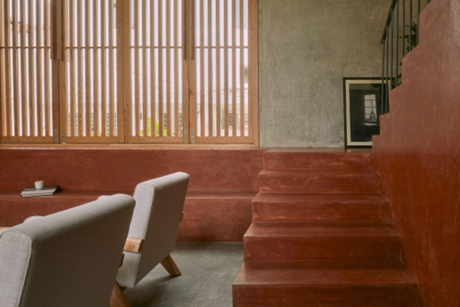
This approach finds a subtle reinterpretation at Cabin House. Influenced by the surrounding old-Bangalore homes, elements rooted in vernacular architecture are woven into a minimal, contemporarylanguage, where spaces themselves become opportunities for conversation. The main staircase, forinstance, extends into informal seating nooks, akin to a katte, introducing moments of pause withintransition.
Guided by the home’s compactness and verdant setting, the idea unfolds further. An extended sectionfrom the staircase landing morphs into a built-in seating that wraps along the dining space, allowingeveryday activities to spill into shared interactions. This, in turn, shapes how the room is inhabited.
What emerges is a rethinking of katte’s role in today’s context. Through shifts in levels, built-in seating, aflexible layout, and connections to the landscape, Cabin House creates a series of informal thresholds. Itcurates spaces that hold the potential to gather, rather than being defined by it.
In reinterpreting the katte, the intent is to revive a way of inhabiting space that fosters unforcedinteractions and a sense of presence. When architecture facilitates these meaningful moments, ittranscends mere functionality, evolving into a vessel that holds memory and emotion.